

Beauty Trends or Stolen Property? The Case of Painted by Esther

Imitation is the sincerest form of flattery, so they say. But it’s more disheartening than a compliment when someone copies and pastes your idea.
Unfortunately, it’s a tale as old as time for Black creatives and content creators; that’s why black women are taking to social media to defend London-based makeup artist Painted by Esther who claims makeup artist Patrick Ta copied her beauty technique.
Patrick Ta is known for his long list of celebrity clientele including Gigi and Bella Hadid and the Kardashian-Jenner Family.
Before his new transition blush collection hits Sephora on May 28, some girlies on TikTok are already giving the makeup technique a mean side eye.
Patrick Ta, founder of Patrick Ta Beauty, posted a TikTok video giving a tutorial of the collection which features liquid blush, dual-ended blush brush and blurring blush duo. It targets your under eyes to cheek to give an airbrushed effect.
In the caption of the video Patrick Ta wrote “I started working on transition blush 1 1/2 years ago. I wanted to create a product that was specifically made for this blush look. I do not own this look.”
Patrick Ta tagged Painted by Esther in the caption also writing “She is amazing and so talented. She popularized the look through her work and through Olandria. I also have been doing this blush look since 2021. Not the same as Esther but my own version. I am a makeup artist. For context I filmed this video on March 5th. I have nothing but love and respect for Esther.”
Painted By Esther—whose real name is Ngozi Esther Edeme—-has done makeup looks for big names as well including Naomi Campbell, SZA, Kelly Rowland, Chloe Bailey and Tyla.
On May 24, Edeme, 29, shared her side of the story with her more than 305,000 TikTok followers with the caption “I’ll only speak about this once.” At last check, the video has over 413,000 likes.
Edeme said she had weird experiences with Patrick Ta, which she has only expressed to her friends until now. The most recent incident with Patrick Ta was when Edeme was in Los Angeles and she received a booking request for a “do and go."
On the day of the booking, Edeme says she received a text message from her agent stating a member of Patrick Ta’s team wanted to record Esther doing the glam.
Edeme said “No, that doesn’t sit right with me…. that’s not the nature of the job.”
Edeme says she canceled the booking because she thought that was very strange.
Edeme goes on to say she posted a tutorial stating “the holy grail…the secret ingredient is using the powder puff.”
Edeme says Patrick Ta has done the same thing “conveniently right after.”
“If that was really the crux of your technique, you would have made a powder puff. You make brushes. It’s not hard to make a powder puff, you know. It’s very easy actually. It’s the easiest thing to make.”
Edeme stated she did not invent the makeup technique. Edeme says she spends “thousands of her own money constantly buying products, testing new products and experimenting.”
“I am an artist. My driving force is to create and share it. My end goal is to teach and spread my knowledge. I cannot leave this earth harboring my knowledge. My goal is to spread it. I am not a gatekeeper. I have timelines for things.” said Edeme.
In August 2025, Patrick Ta posted a blush application tutorial. In the comment section of that TikTok video, a user asked “I thought you did powder before cream?”
Patrick Ta replied “I switched for the painted by Esther look.”
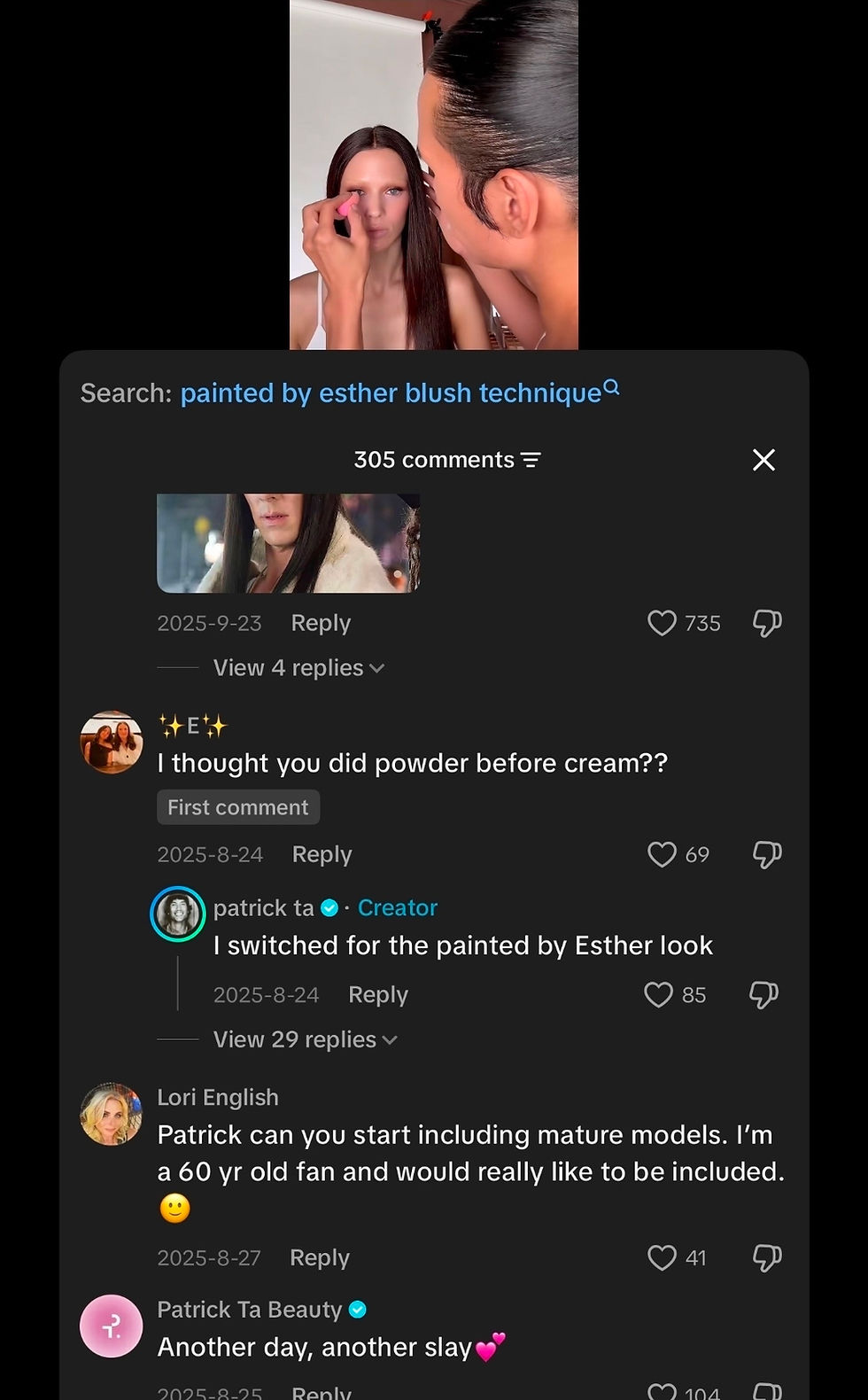
“It’s already hard being Black...being a woman in this industry. You genuinely have to fight twice as hard to get just half of what you deserve.” said Edeme.
Some content creators did research of their own and attributed the origin of the makeup technique to Korean beauty and to the late beauty influencer Kevyn Aucoin, the brilliant artist behind iconic looks of 90s supermodels. The makeup legend passed away at the age of 40 in May 2002 from kidney and liver failure.
The TikTok account for Kevyn Aucoin Beauty responded to the drama writing “Long before the term started circulating online, this technique was first published by legendary makeup artist Kevyn Aucoin… and later refined by incredible artists like Painted By Esther.”
In 2018, the neo-blush was created with the purpose of honoring Aucoin’s legacy and teachings.
The recent drama brings up similarities to the fiasco between beauty creator Yahne and e.l.f Cosmetics. After a collaboration between Yahne and the brand fell through, Yahne called out e.l.f Cosmetics for stealing her “face card never declines” branding and likeness for a marketing campaign. Yahne also claimed Neutrogena have used her likeness and brand identity as well.
Yahne says her lawyer emailed e.l.f Cosmetics to settle the matter offline. Yahne says she sent the company a cease and desist. Yahne provided an update saying e.l.f cosmetics replied to her lawyer and said “they are doing nothing to resolve this.”
The challenge for creators is that makeup techniques and phrases often fall into a legal gray area. But, there are still steps you can take. According to Harvard University, the U.S. Copyright Act states as soon as a creator sets a work down in a tangible medium, the creator has the exclusive right to protect it including books, software, architectural designs, motion pictures and sounds recordings. However, ideas, facts, discoveries, procedures or works created by the U.S. federal government are not protected.
So what does that mean moving forward?
According to United States Patent and Trademark Office, establish legal ownership.
Register your work with your national copyright office, keep track of timestamps and trademark your brand.
In addition, you can add watermarking and signatures to your content.
If your content is stolen and uploaded to other websites, make sure you report it using the platform’s standard copyright infringement or DMCA (Digital Millennium Copyright Act) Takedown form.
You can also send a cease and desist letter stating your legal rights so the stolen content can be removed without needing to go to court.
Lastly, use monitoring tools like Google Reverse Image Search to regularly search for your work online.


Comments