

“Is God Is” And The Mirror It’s Holding Up To All Of Us

By Renee Creer
Last week I had the opportunity to attend an early screening of Aleshea Harris “Is God Is”, originally a stage play turned film.

And my… This film hit me in so many ways. While I’m not a twin, my older sisters are identical twins and being on the outside looking in, there is something magical about that twin connection. We all know the “universal Black person look”, where we know what we are thinking without saying a word. But it’s on a different level with twins. Their communication throughout the film leans heavily into how connected they are without even having to utter a word.

We are first introduced to Anaia, and Racine, twin sisters raised in poverty and scarred by their father’s violence against their mother and themselves after she divorced and put a restraining order against him. As children, they are told how “ugly” they are, which later you realize it’s due to the third degree burns they endured while trying to help their mother after their father lit her on fire. One twin gets emotional while being teased and the other… well, takes on a more hands on approach with their bullies.
The film’s twin dynamic is its most psychologically rich feature. Anaia and Racine are not simply two halves of a whole; they have very different approaches on how to survive in the world. One internalizes, one externalizes. One questions, one acts. Racine is the more impulsive of the two, always ready to throw down in order to protect herself and her sister. Anaia, meanwhile, is the more conscientious one, carrying a moral weight that functions like a voice of reason when her sister is feeling impulsive. Throughout the film, we get to experience the twins as both an inseparable unit while growing into their own identity as they are forced to face unhealed wounds from the past.
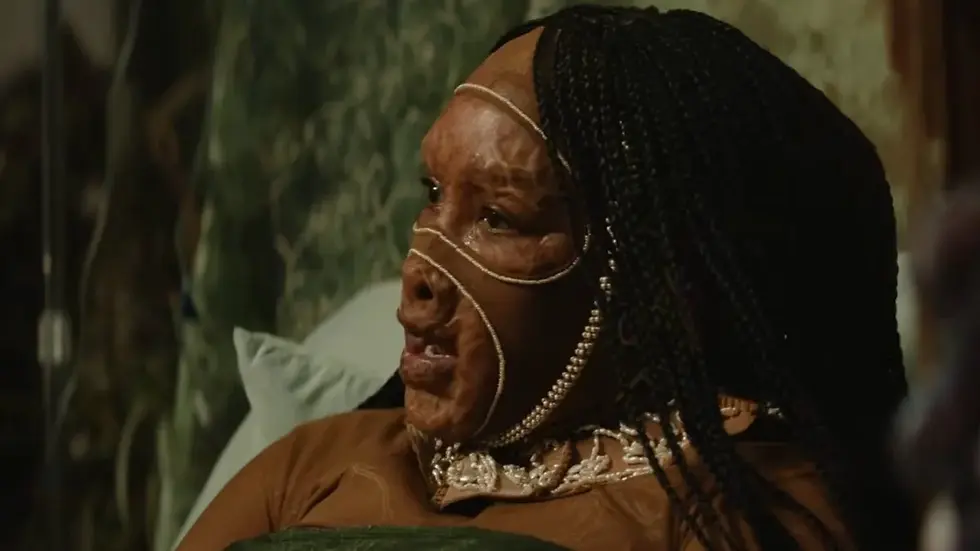
When their dying mother tells them to find and kill their father, the girls must each confront who they are outside of being a unit, outside of being defined by the man who destroyed their family. Their journey is, at its core, who am I when everything that made me is gone?

Mind you, both parents have not been in their lives… Their mother, played by the icon Vivica A. Fox, had not reached out to her children in over a decade. They thought she passed away in the fire. Yet, she reached out for them to fulfill this final wish, almost in a Kill Bill like fashion. This is the first time you truly see the twins struggle to be on the same page with what to do. Racine, who originally wanted to murder their mom for not reaching out for so long, was down to take their father out while Anaia had so many mixed emotions and hesitancy. She not only questioned Racine’s unwavering loyalty to their mom, who essentially allowed them to be passed around through foster care and believe that she was gone, but was wondering if she herself was even capable of doing such an act.
Ultimately she agrees after Rancine kind of manipulates her by telling her she is “weak” for being emotional and asking so many questions and making her imagine how normal life would be if their dad didn’t light their mother on fire. This plays into the whole twin dynamic where they aren’t necessarily as equal as Anaia thought and makes her start to question is she just walking in Rancines shadow, and doing as she’s told.
And with that, they start their journey to find their dad and kill him. And their first stop: To meet their dad’s significant partner, Divine.

Divine, played by Erika Alexander, represents something pretty insidious. She runs a small cult like church, which plays into the religious extremism within the Black community. Despite his rancid behavior toward her, she romanticized her time with him, keeping him on a pedestal, quite literally tending a shrine to him. We see in this moment that it reflects organized religion’s convenient blindness when it comes to abuse in the household. Her God is a God of male authority, of ordained suffering, of obedience as virtue. Her faith is not a comfort, it is a leash she mistakes for wings. And this was not only a survival tactic, but her devotion has essentially metastasized into delusion and religious psychosis as a way to cope with his absence once she got pregnant. While I wouldn’t go as far to say that she was complicit with his actions, her religious background conveniently let her turn a blind eye to his past and the harm that he also perpetuated onto her as well.
Again this is a point where the twins have very different approaches. Anaia seems to hold some form of empathy for Divine that she did what she needed to do to survive, yet Rancine is taken aback on how she can still view him in a positive light.
After some back and forth they are forced out of the church and continue their journey, meeting the lawyer that helped their dad get off from all charges against their mother.

This scene was interesting. The former lawyer cannot speak because their father ripped out his tongue , as he was fearful he might talk to authorities about his plan to go back and “finish the job” for both his ex wife and the twins.
It shows how while there a LOT of men that are complicit to their male friends' actions against women, there are some willing to hold them accountable and speak out. And with that…There are some ramifications. We point out that so many men are complicit to their friends' wrong doings, but some hold back in fear. Which… personally I believe you should absolutely hold abusers accountable for their actions. But Harris highlights this to humanize this reality.
I believe it also highlights another aspect that the twins are starting to learn about their father:
He is not an aberration. He is a pattern.
And that pattern has a body count. They believe their dad rode off into the sunset and put the incident past him (which… he basically did), but that it was a one off situation. Which they are realizing… the abuse did notjust stop with them.
The twins finally arrive at their father’s current life, and they are met with a cruel gut punch. They expect to find a monster in a cave. What they find instead is a man who has built something that looks, from the outside, like a life well-lived. A new home. New children. A curated respectability. The happily-ever-after they were never permitted to have, funded by their abandonment. Their father avoided punishment and had more children along the way; each new family a fresh coat of paint over the rot underneath. The twins have every right to feel the vertigo of that moment. They survived fire, foster care, disfigurement, and isolation while he was simply moving on. The comfortable life he built is not proof that he changed. It is proof of how little they ever mattered to his calculus.

Then there is Angie, played with coiled brilliance by Janelle Monáe. She is the father’s current wife, who is quietly planning her own exit from the same man. Angie’s monologue about being the perfect wife, knowing her place in a relationship heavily influenced by gender roles and misogyny, highlights how you can be there best partner, fulfill every need, and that won’t stop the mistreatment and abuse from coming your way. Her character is almost used to emphasize the “perfect victim...” a beautiful, educated, affluent black woman who is being abused by her husband.
Although Angie is engineering her own escape, she’s met with the twins holding her from driving.


I will say, as much as I believe that the twins have every right to feel slided, angry and frustrated to find their father living this luxurious life with his new family, I believe the anger in this moment was misguided. That is until she badmouths Racine and Anaia’s mother, insisting that “any self-respecting woman would leave” if she were in a dangerous relationship. It is one of the film’s most precise and devastating observations. Angie represents a particular strain of Black elitism. The performance of being above the circumstances she is, in fact, inside. Her confrontation with the twins carries a specific class-coded contempt: the implication that their mother’s failure to leave was a character flaw, a poverty-of-spirit problem, a personal failing rather than a structural trap. She has convinced herself that her education, her polish, her strategic planning make her departure not only possible but morally superior to women who could not or did not go.
Harris does not let her off the hook. Angie’s victim-blaming is not presented as wisdom. It is presented as armor. The reality that separation is statistically the most dangerous moment in an abusive relationship is something Angie has the luxury of ignoring because she hasn’t left yet. Finances, housing instability, shared children, and the very real threat of escalated violence keep countless women trapped in dangerous homes.
Two incidents that come to mind were just last month. On April 19, Shamar Elkins opened fire across multiple homes in Shreveport, Louisiana, killing eight children; seven of them his own, ranging in age from three to eleven. Authorities described the incident as entirely domestic in nature, stemming from a separation Elkins could not accept. Days earlier, Dr. Cerina Fairfax, a devoted mother and dentist in Annandale, Virginia, was murdered in her own home by her estranged husband, former Lieutenant Governor Justin Fairfax, who then took his own life. Cerina had tried to leave two years prior. She had filed for divorce. A court had ordered her husband out of the home by the end of the month. She did everything the Angie's of the world insist women should do. It still cost her her life. Domestic violence is a leading cause of death for Black women between the ages of 18 and 45.
Angie’s class position allows her to theorize around while she herself remains in the same house as a man who has already proven what he is capable of. Her sneer at the twins’ mother is the sound of a woman maintaining her own denial. Which ultimately led to her own downfall, which Rancine made sure of.
After killing Angie, the twins go to the house to wait for their father to come home, but they go to interact with their half siblings Scotch and Riley, who also happen to be twins. There are a lot of uncomfortable parts throughout their interactions with the male twins but a theme that was highlighted was although they were brought up with a lot of privilege, access, and more, there were still some similarities between them.

This is where we see the individual identity start to be questioned. Racine and Scotch are the more conventionally attractive, impulsive twins that tend to be more dominant in their dynamics, where as Anaia and Riley are more hyper sensitive, seen as quiet and weak compared to their siblings. We see them truly start to question if they are living in their twins shadow and who are they really without the “prominent” twin.
However, the bonding moment that Anaia and Riley share is short lived, after Rancine murders Scotch for calling her sister ugly. A trigger since adolescence. And after Riley tries to retaliate he also meets his end, by the hands of Anaia. And in this pivotal moment, she seems to realize her capabilities of fulfilling her mom’s request, especially considering she has to do it alone as Rancine is completely unconscious from the scuffle.
And the moment comes… in walks the father… with some hideous boat shoes.
This was one of the very few moments the theater broke out in laughter. Because what were THOSE?!
The father himself is perhaps the film’s most chilling achievement. A man whose casual cruelty, confident charm, and promises of change constitute a cycle his victims recognize viscerally. Harris’ decision to credit Sterling K. Brown’s character only as “Man” is not stylistic whimsy. It is a thesis statement. He is a walking pattern. And the viewers are reminded of that when he strikes Anaia, even after learning that she is pregnant. And has absolutely no remorse for anything. He says so himself about his actions decades ago and that he would do it all over again if given the chance.
Sterling K. Brown gives a phenomenal performance, so much so, I would argue he is pretty much hated just as much as Blair Underwood and Richard T. Jones after playing their most villainous characters.
Anaia is able to complete the task with the help of her sister since she finally regained consciousness, but as quick as they were to celebrate their feat, tragedy hits just as fast as Racine is pulled into the fire as her dad grabs her.
This leaves Anaia all alone for the first time ever. Realizing how quiet it is. And now she must stand on her own.
While I get not having a happy ending, I do feel like this part was extremely rushed. I wish as a viewer we had more time to sit with what happened, see her go through a little bit of the motions of what this process looked like of not only losing your twin sister but your best friend.
Final thoughts: “Is God Is” does not ask us to feel sorry for Anaia and Racine. It asks us to feel the weight of a world that made their revenge logical, even righteous. Harris builds a moral universe where the audience is implicated, where laughter and horror occupy the same breath, where God may or may not exist but fathers absolutely do, and their violence has consequences that outlive them.
This film is a reckoning. And in a spring that offered up Shreveport and Annandale, it is also a eulogy for every woman told to simply leave, as though leaving were ever just that simple.


Comments